
In this week’s edition, we briefly explore resilience in times of crises, highlighting how Open Science can withstand geopolitical pressures and sharing resources to learn more. We highlight the new partnership between Mela Dreams Africa and Access 2 Perspectives, supporting Africa’s emerging scholars. We feature a conversation with Beth Bayley from Karger Publishers on sustainable Open Access and Open Science practices, and share a preview of our Course Catalogue, Research Health Check resources, and Verime Survey.
Workshop Highlight: Resilience in Times of Crisis-Strengthening Open Science Against Geopolitical Pressures
Hosted at the Centre for Science and Technology Studies (CWTS), Leiden University, this workshop explored how the global Open Science community can remain resilient amid growing geopolitical tensions and crises.
As Open Science depends on openness, accessibility, and sustainable infrastructure, current global conflicts and political shifts – from Sudan to Ukraine to Gaza-highlight how fragile open knowledge systems can be. The workshop invited participants to co-create strategies that strengthen the foundations of Open Science through collaborative dialogue, “unconference” discussions, and collective position statements.
With disappearing services and increasing instability, the need to protect and adapt open research systems is more urgent than ever.
We encourage readers to learn more about this timely topic and reflect on how global events shape access to knowledge. Stay tuned, we will soon share additional resources and insights on Open Science resilience.
In the meantime, explore related resources:
Partnership Announcement: Access 2 Perspectives & Mela Dreams Africa.
Mela Dreams Africa — From Ideas to Impact
Founded by Keletso Masisi, a changemaker passionate about youth empowerment, Mela Dreams Africa is a youth-led initiative dedicated to unlocking the potential of young Africans through education, leadership, innovation, and open access to knowledge. The organization bridges the gap between untapped African talent and global opportunities, nurturing a confident generation ready to shape the continent’s future.
This collaboration reflects our shared vision to strengthen research literacy, scholarly development, and capacity-building across Africa.
Together, we aim to equip emerging African scholars and learners with the tools, mentorship, and mindset to transform ideas into impact, driving sustainable progress led by Africans, for Africa, and beyond.
Exploring Open Access Models as a Scholarly Publisher
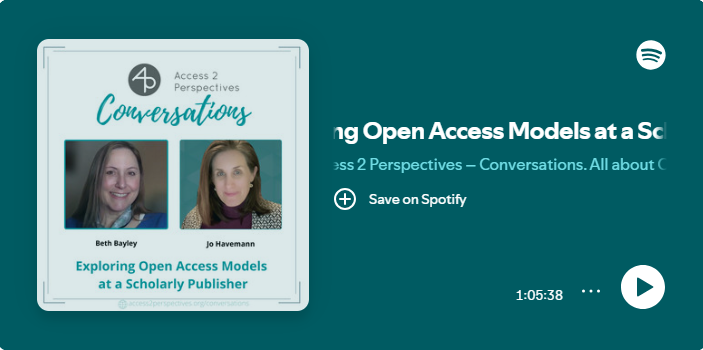
Guest: Beth Bayley.
Beth Bayley, Open Science Manager at Karger Publishers in Switzerland, shares insights into her work leading Karger’s Open Science Task Force and Ambassadors Program. With a background in journalism and over a decade of experience in Open Access, Beth discusses Karger’s journey toward sustainable Open Access, beginning with their first OA journal in 2017.
She reflects on the publisher’s broader Open Science initiatives, including open data, FAIR data principles, and open peer review. She also elaborates on the ethical considerations of sharing medical research data and the value of open methodologies for transparent and reproducible science.
Listen to the conversation: A conversation with Beth Bayley
Verime Survey: Share Your Experience on Online Privacy and Identity
This initiative, dedicated to strengthening trust and transparency in research identity and verification, is inviting researchers and scholars worldwide to share their experiences with online privacy and identity management.
The short 5-minute survey seeks to understand how individuals navigate issues of identity and privacy in research and scholarly contexts. Your input will help shape a community-wide conversation about digital identity and privacy – one that centers researchers’ voices and informs the design of platforms and infrastructures supporting open scholarship.
The survey is anonymous and hosted on a privacy-first, encrypted platform. You can also register for regional focus groups to explore these topics further, and you will receive a Verime membership discount code upon completing the survey.
Survey open: 8 September – 31 December 2025.
Available globally and in multiple languages.
Take the survey here: verime.coop/blog/what-do-you-think
Research Health Check
The Research Health Check is a practical resource designed to help researchers assess the robustness, efficiency, and impact of their research practices. It offers tools and guidance to strengthen your workflows, ensure compliance, and maximize your research visibility.
Every researcher deserves the clarity and support to thrive, and this is one step toward that.
Research and Writing Skills
This section explores your ability to critically engage with academic literature, structure your writing for maximum impact, and navigate the complexities of the publishing process. These skills are essential for producing high-quality research and effectively communicating your findings.
4. Ethical Considerations
Are you familiar with ethical issues in academic publishing, such as predatory journals or authorship disputes?
a) Very familiar; I actively avoid predatory practices and address authorship issues. (
b) Somewhat familiar; I am aware, but have limited experience addressing these issues.
c) Neutral; I have heard of these issues but lack understanding.
d) Not familiar; I am unaware of these ethical considerations.
Take the full Research Health Check
A2P Course Catalogue

Our training programs are aligned with the UNESCO Open Science Recommendation and adhere to scholarly standards, principles, and best practices that facilitate global collaboration, transparency, and accessibility.
We provide customized training and consulting services for researchers, institutions, and organizations.
OPEN SCIENCE PRACTICES
1.1. Introduction to Open Science
This course introduces key aspects of the principles and practices of Open Science, emphasizing its intended
purpose and the benefits for global scientific collaboration and inclusivity while highlighting some of the concerns and considerable aspects. Participants will learn how to seamlessly include Open Science practices in
their research workflows.
Contents
❖ Open Science principles and resources
❖ Exploring the opportunities and limitations of openness
❖ Reproducibility and reusability of research outcomes
❖ Digital tools to facilitate global research collaboration
❖ Guidelines and Incentives for Open Science by national and international institutions
Objectives
❖ Understand the core principles and benefits of Open Science.
❖ Learn practical steps to make research outcomes accessible.
❖ Explore digital tools for global research collaboration.
Outcomes
❖ Participants adopt Open Science practices across the research workflow.
❖ Increased ability to share and reuse research data.
❖ Enhanced understanding of global scientific collaboration.
Explore our full Course Portfolio and discover more course topics.