
Welcome to this week’s edition of our newsletter! We are a training and consulting organization for globally inclusive research and science communication, connecting research communities worldwide through open knowledge, collaboration, and shared learning.
In this week’s edition, we are excited to start with our big news: UbuntuNet Alliance, in partnership with AfricArXiv and global collaborators, has won the IOI Grant, marking a historic milestone in strengthening Open Institutional Repositories across Eastern and Southern Africa.
Next, we highlight an upcoming webinar on 5 December 2025: “DataCite Insights: Strengthening Open Science and Research Visibility in Africa,” exploring how persistent identifiers (PIDs) and open metadata can boost African research visibility.
We also revisit a Podcast episode with Richard Jefferson, on Turning Science into Social Outcomes. Finally, don’t miss a preview of our Course Catalogue and the Research Health Check questionnaire.
Almost a Decade in the making – UbuntuNet Alliance Wins IOI Grant!

Since our launch of AfricArXiv by the hands and brains of Justin Ahinon and Dr. Jo Havemann back in 2018, we are now proud to report:
Our partner organisation, and now mothership of AfricArXiv, UbuntuNet Alliance, has reached a major milestone in receiving one of the very few grants IOI Fund for Network Adoption, strengthening Open Institutional Repositories (OIRs) across Eastern and Southern Africa, an effort nearly a decade in the making.
This is huge news for African research:
- 1,000+ librarians, researchers, and engineers will receive hands-on training
- 960+ datasets will now be openly accessible to researchers, policymakers, and communities
A big step toward a connected, open science ecosystem in Africa!
What This Means for Africa:
- African research is now more visible on the global stage.
- Local institutions are better equipped to manage open data and repositories.
- Researchers, policymakers, and communities gain access to high-quality datasets that inform evidence-based decision-making.
Upcoming Webinar: DataCite Insights – Strengthening Open Science and Research Visibility in Africa

5 Dec 2025 | 11:00 AM CAT / 10:00 AM WAT / 12:00 PM EAT
Speaker: Mohamad Mostafa – DataCite Community Specialist, UNESCO Working Group on Open Science Infrastructures member. Case Study Presenter: Ahmed Siyad – SomaliREN, UbuntuNet DataCite Consortium.
Learn how persistent identifiers (PIDs) and open metadata can transform the discoverability and impact of African research. Mohamad will provide an overview of DataCite’s global community and services with practical use cases from across Africa, while Ahmed will highlight SomaliREN’s experience implementing open research infrastructure.
Highlights:
- How PIDs support interoperability, policy alignment, and equitable participation in global research ecosystems
- Practical use cases from across Africa, including SomaliREN
- UbuntuNet Alliance’s role in strengthening repository systems and open research infrastructure
For: Policymakers, higher education ministries, librarians, repository managers, research administrators, university leaders, and researchers across Africa
Register for the Webinar: Explore the AfricArXiv Open Science Webinar Series
Turning Science into Social Outcomes
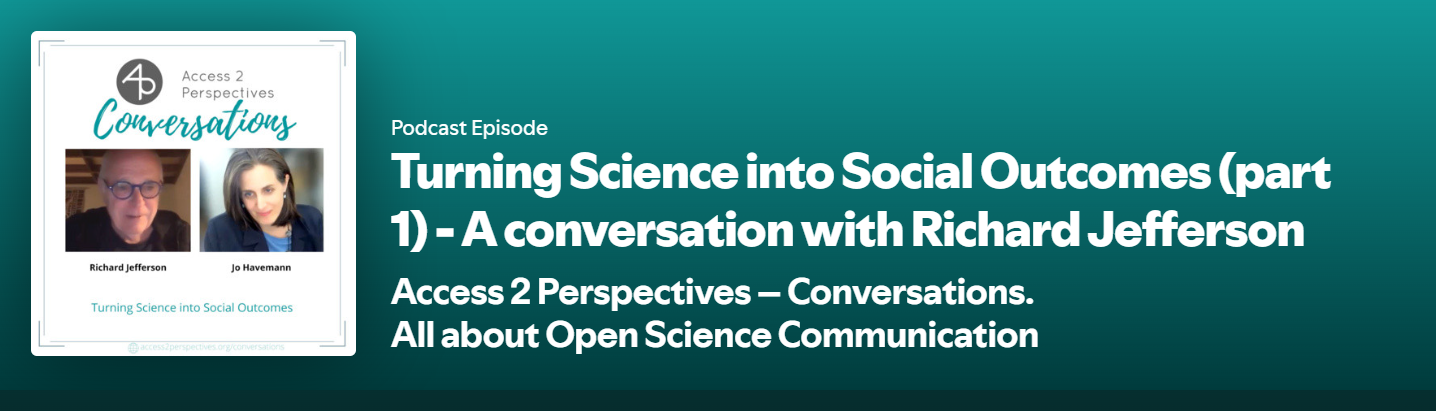
A conversation with Richard Jefferson
In this two-part podcast series, Richard Jefferson, molecular biologist, social entrepreneur, and founder of Cambia and The Lens, shares his journey in science, open innovation, and building systems that turn research into real-world social impact.
Hosted by Dr. Jo Havemann, the conversations explore how open science and inclusive innovation can help address some of the world’s most pressing challenges.
Explore all episodes on our Conversations page.
Research Health Check
The Research Health Check is a practical resource designed to help researchers assess the robustness, efficiency, and impact of their research practices. It offers tools and guidance to strengthen your workflows, ensure compliance, and maximize your research visibility.
Every researcher deserves the clarity and support to thrive, and this is one step toward that.
Collaboration and Data Management
Collaboration and data management are critical for modern research, especially in global and interdisciplinary contexts. This section examines your experience with managing international collaborations and your familiarity with FAIR principles for research data.
6. (a) #beFAIR in Research Data Management (RDM): Are you familiar with the FAIR principles (Findable, Accessible, Interoperable, Reusable) for research data management and how to apply them to your own work? If not, what are the barriers?
a) Yes, I apply them regularly
b) Somewhat; I have implemented some aspects of FAIR principles, and I face significant barriers
c) I’ve heard of them, but don’t apply them
d) No, I’m not familiar
Take the full Research Health Check
A2P Course Catalogue

Our training programs are aligned with the UNESCO Open Science Recommendation and adhere to scholarly standards, principles, and best practices that facilitate global collaboration, transparency, and accessibility.
We provide customized training and consulting services for researchers, institutions, and organizations.
OPEN SCIENCE PRACTICES
1.3. Communicating Research Outcomes Effectively
This course focuses on strategies for communicating scientific
findings to diverse audiences and promoting inclusivity and transparency in science communication that is of local, regional, and/or global relevance. Participants will explore tools and techniques for engaging the stakeholders of their research, tailoring messages for non-academic audiences, and leveraging communication
platforms to share research outcomes.
Contents
❖ Strategies for Stakeholder engagement, identifying and working with different audience groups,
including policymakers, educators, and the general public.
❖ Multilingual communication to increase global reach.
❖ Leveraging communication platforms like LinkedIn and YouTube to share findings and connect with
broader audiences.
❖ Addressing biases, misinformation, and ethical dilemmas in disseminating research findings.
❖ Evaluating and measuring the effectiveness of science communication initiatives through feedback and
analytics.
Objectives
❖ Develop effective science communication skills.
❖ Learn techniques for engaging non-specialist audiences.
❖ Explore ways to make science communication globally inclusive
Outcomes
❖ Creation of accessible and engaging science content.
❖ Increased public awareness and participation in science.
❖ Enhanced ability to communicate complex ideas across cultural and linguistic boundaries.
Explore our full Course Portfolio and discover more course topics.
Thank you for Being Part of our Community!
As part of our mission to advance globally inclusive research and science communication, Access 2 Perspectives continues to support scholars and institutions through training, consulting, and open collaboration.
Share this with peers who might benefit, and let us keep strengthening the culture of openness and shared learning in global research.