Earlier this year at the 3rd Global Diamond Open Access Summit, I met Ablaz Mohammed Schemnad, a young, highly dedicated, and talented policy researcher and science communicator. The conversations we had left me with a lasting impression and touched on his research interests, projects, and initiatives, as well as our respective viewpoints on Academia with its current strengths and weaknesses, including institutional responsibility towards its staff and society.
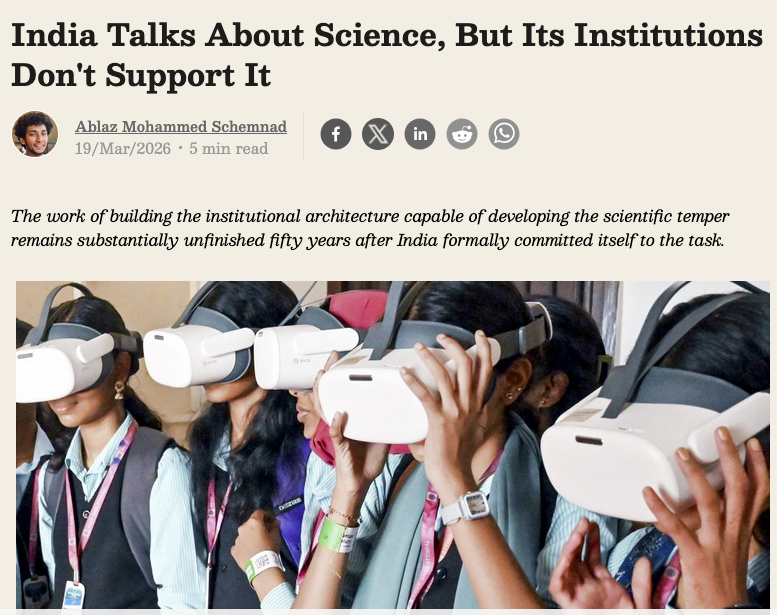
Today, Ablaz notified me about an article he recently wrote and published, in which he distills his thoughts into a constructive critique of India’s scientific ecosystem, arguing that while the country formally enshrined the duty to cultivate a “scientific temper” in its constitution, the institutional foundations needed to support this vision remain incomplete.
Ablaz highlights a persistent gap between ambition and execution: low research and development (R&D) investment, limited private sector participation, and tightly controlled research institutions constrain innovation despite a large pool of STEM talent. In his view, administrative inefficiencies, especially in funding disbursal, further impede progress. At the same time, distorted academic incentives have contributed to a declining quality of research, with an overemphasis on publication volume rather than rigor.
Ablaz concludes that the responsibility to foster scientific temper cannot rest solely on citizens at large or individual researchers specifically, when the state has yet to create enabling institutional conditions. The challenge, he argues, is not public awareness but governance, requiring deeper reforms towards institutional autonomy, funding opportunities, and accountability.
Read the full article here: https://thewire.in/science/india-talks-about-science-but-its-institutions-dont-support-it