
Lanfrica and AfricArXiv Announce Strategic Partnership
of African language resources in Africa including initiatives related to natural language processing and indigenous language dissemination.
of African language resources in Africa including initiatives related to natural language processing and indigenous language dissemination.
borate to increase awareness of supporting discoverability in Africa through metadata and integrations between repositories and indexing platforms.
“Hardware is a vital part of experiments process and advances in instrumentation have been central to scientific revolutions by expanding observations beyond standard human senses.” But making hardware and especially sharing hardware is neither an easy nor a recognized task in academia. In order to tackle this issue, some of us started a Research Data Alliance (RDA) interest group.
In our pursuit to join efforts with African institutions to be of service for African researchers and other scholarly stakeholders, we are glad to announce our partnership with Aphrike Research.
AfricArXiv, Eider Africa, eLife, PREreview, and the Training Centre in Communication (TCC Africa) invite nominations for researchers in the fields of life sciences and medicine who will help co-create and then disseminate resources promoting best open peer-review practices in Africa.
Eider Africa, PREreview, AfricArXiv, and the Training Centre in Communication (TCC Africa) are working together on a new peer-review training program for early to mid-career researchers in Africa, facilitated by eLife. The course aims to raise awareness around preprints and invite African researchers/scholars to the open review of preprints.
The Training Centre in Communication (TCC Africa), based at the University of Nairobi, Kenya, and the pan-African Open Access portal AfricArXiv herewith announce our formal collaboration agreement with the objective of creating a long-term strategic and sustainable approach to building and managing an international scholarly community that will enrich the visibility of African research.
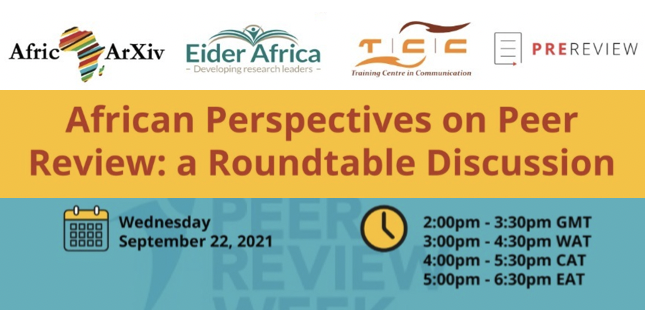
AfricArXiv, Eider Africa, TCC Africa, and PREreview are pleased to host a 60-minute long roundtable discussion, bringing African perspectives to the global conversation around this years’ Peer Review Week’s theme, “Identity in Peer Review”. Together with a multidisciplinary panel of African editors, reviewers and early-career researchers, we will explore the shifting identities of researchers in the African continent, from the dominant perspective that sees them as consumers of knowledge produced in other contexts to researchers who are actively engaged in scholarly peer review. We will strive to create a safe space for reflection around issues of scholarly knowledge decolonization, bias in peer review, and open transformative peer review practices.
Decolonise Science will employ translators to work on papers from AfricArXiv for which the first author is African, says principal investigator Jade Abbott, a machine-learning specialist based in Johannesburg, South Africa. Words that do not have an equivalent in the target language will be flagged so that terminology specialists and science communicators can develop new terms. “It is not like translating a book, where the words might exist,” Abbott says. “This is a terminology-creating exercise.”
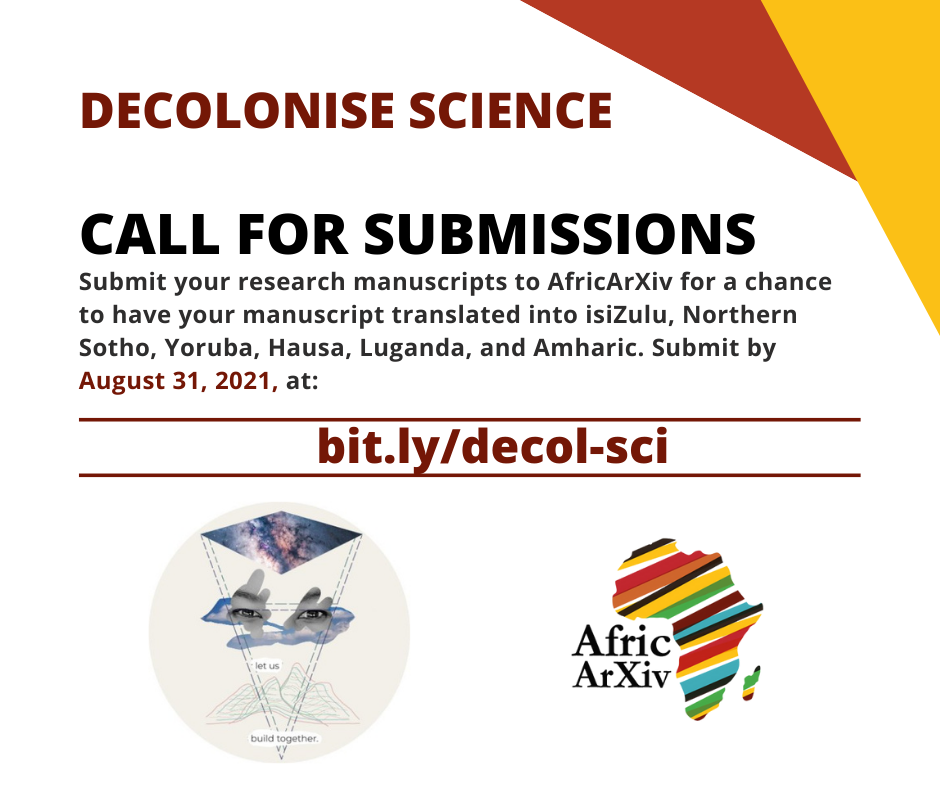
The team at AfricArXiv is proud to announce that we are partnering with Masakhane to build a multilingual parallel corpus of African research from translations of research manuscripts submitted to AfricArXiv. Of the articles submitted, the teams at Masakhane and AfricArXiv will select up to 180 in total for translation.